
'You are Leader of Opposition. Say things in Parliament, why do you have say it on social media?'

The Congress on Wednesday alleged that the government has announced the start of the Monsoon session of Parliament 47 days before it is due in order to run away from the demand of the party and Indian National Developmental Inclusive Alliance (INDIA) for an immediate special session to discuss the Pahalgam attack and the Centre's failure to bring the terrorists to justice.
'The definitions in the Act are so wide and so vague that they can be easily misused to target individuals who may not be conducive to the present government in power.'

The BJP on Saturday disassociated itself from the criticism of the Supreme Court by its MPs Nishikant Dubey and Dinesh Sharma. Party president J P Nadda rejected the comments as their personal views and affirmed the ruling party's respect for the judiciary as an inseparable part of democracy. Nadda said he has directed both the leaders and other members of the party to not make such comments.
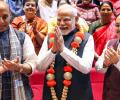
In his first address to National Democratic Alliance MPs in over a year, Prime Minister Narendra Modi on Tuesday emphasised its collective identity as a natural and organic alliance, asserting that its journey since its foundation in 1998 is dotted with successes and has many more achievements in store.
The BJP had no option but to get Jagdeep Dhankhar out of its way for the sake of the Modi government's stability, reveals Sheela Bhatt, the legendary political journalist.

While naming him as the NDA candidate for the Vice President's post, the BJP had described him as 'Kisan putra', a move seen in the political circles aimed at reaching out to the politically significant Jat community which had participated in huge numbers in the year-long farmers' protests against agriculture reform measures unveiled in June 2020.

A Supreme Court lawyer has written to the Attorney General seeking consent to initiate contempt proceedings against BJP MP Nishikant Dubey for his "grossly scandalous" remarks against the court. Dubey had criticized the Supreme Court and Chief Justice of India Sanjiv Khanna following the Centre's assurance that it would not implement some of the contentious provisions of the Waqf (Amendment) Act. The BJP has distanced itself from Dubey's comments, calling them his personal views.

'Talking about boycotting polls is simply a move to galvanise party leaders, workers, and supporters for the big political fight.'

The BJP lawmaker sparked a row when he said, "(the) Supreme Court is taking the country towards anarchy" and that "Chief Justice of India Sanjiv Khanna is responsible for the civil wars taking place in the country".

'The protection of secrecy and anonymity gets lost with this linking.'
BJP and RSS leaders are once again pushing to remove the words 'secular' and 'socialist' from the Constitution's Preamble, showing a deeper effort to change India's identity from a diverse, multi-religious republic to a Hindu-first nation, even though they don't have the numbers in Parliament to officially change the Constitution, observes N Sathiya Moorthy.

Reliance Group Chairman Anil Ambani on Tuesday appeared before the Enforcement Directorate here for questioning in a money laundering case linked to alleged multiple bank loan fraud cases worth crores of rupees against his group companies, official sources said.
The Congress party has accused the BJP of engaging in "damage control" after the party distanced itself from comments made by two of its MPs, Nishikant Dubey and Dinesh Sharma, criticizing the Supreme Court. Congress general secretary Jairam Ramesh stated that the BJP's clarification was merely an attempt to mitigate the damage caused by the MPs' remarks and that the party's actions were hypocritical, given the silence of the BJP president on similar comments made by other party members.

The Enforcement Directorate has summoned Reliance Group Chairman Anil Ambani for questioning in a money laundering case linked to alleged bank loan fraud.

Union Parliamentary Affairs Minister Kiren Rijiju on Wednesday underlined the government's resolve to take all political parties on board in moving an impeachment motion against Justice Yashwant Varma, saying corruption in the judiciary cannot be approached through a 'political prism'.
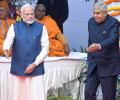
The RSS which catapulted Jagdeep Dhankar to national prominence after 21 years of hibernation could not come to his rescue when BJP higher ups decided to seek his resignation, points out Prakash Bhandari.

Sharad Pawar claimed that two individuals had met him in New Delhi before the 2024 Maharashtra assembly polls and 'guaranteed' the Opposition's victory in 160 of 288 constituencies.

Her black bag had "National Herald Ki Loot" emblazoned over it in red colour.

Implementation of sports bill in 6 months, regulation of participation standard safeguard: Mandaviya
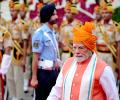
'The Election Commission's involvement in the avoidable SIR controversy has carried a message down to the last voter -- who just does not like it,' observes N Sathiya Moorthy.

Several leaders of the BJP and its allies are of the view that the NDA this time is unlikely to follow the instincts that made it pick Dhankhar and will be more conventional in its search for his successor.

'Militants are taking over the administration. Fundamentalists have been released from jail.'

Dubey launched a broadside against the Supreme Court on Saturday, saying Parliament and state assemblies should be shut if the apex court has to make laws.

Former Union Law Minister Ashwani Kumar has argued for replacing the existing collegium system for judicial appointments, asserting that public sentiment leans toward an alternative mechanism, potentially resembling the National Judicial Appointments Commission (NJAC). He believes that the government has the authority to propose a revised constitutional amendment for judicial appointments that would withstand judicial scrutiny. Kumar also urged the Supreme Court to establish a robust internal process to address concerns within the judiciary, including allegations against judges.
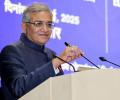
As an IAS officer in Kerala, Gyanesh Kumar -- who the Congress described as Amit Shah's 'right hand man' -- had a good working equation with the state's Congress and Left leaders.

The Rajya Sabha secretariat has verified the signatures of 44 of the 55 MPs who had signed a notice to bring a motion for the removal of Allahabad high court Judge Shekhar Yadav over his 'hate speech' even as Kapil Sibal and nine others were yet to verify their signatures.
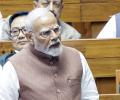
Besides the not-so-hidden unease between Modi and Adityanath, Modi chose to address the Lok Sabha to ensure that he could personally claim all the kudos, observes Nilanjan Mukhopadhyay.

The Centre on Wednesday told the Supreme Court that nobody can claim right over government land and it is legally empowered to reclaim properties which are declared waqf by using the waqf by user principle.
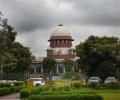
The Supreme Court of India has sought responses from the Centre and others on a petition challenging the constitutional validity of certain provisions of the Waqf Act, 1995. The petition argues that the Act gives undue favor to waqf properties and deprives non-Muslims of their property rights. The court has tagged the petition with pending petitions that raise similar issues.

'Pakistan will also try to turn Bangladesh into a base for terrorist attacks on India.'

Four-time Odisha MP Pinaki Misra's wedding to firebrand TMC MP Mahua Moitra in a quiet, intimate ceremony that chose privacy and tradition over fanfare, was a reflection of his personal style.
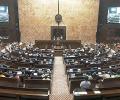
President Droupadi Murmu has given her assent to the Waqf (Amendment) Bill, 2025, which has sparked controversy and legal challenges. The Bill, passed by Parliament after heated debates, has been criticized by opposition parties as "anti-Muslim" and "unconstitutional". The government, however, maintains that the reform will benefit the Muslim community. Several petitions have been filed in the Supreme Court challenging the constitutional validity of the Bill, alleging discrimination against Muslims and undermining their religious autonomy. The Bill repeals the Mussalman Wakf Act, 1923, and introduces restrictions on Waqf properties and their management, which have raised concerns about the impact on the Muslim community.
Two-time Trinamool Congress Lok Sabha MP Mahua Moitra is learnt to have quietly tied the knot with Biju Janata Dal leader Pinaki Misra on May 3.

Several opposition MPs have made a similar demand to the government in the wake of the dastardly attack in which 26 people, mostly tourists, were killed last week, leaving the nation grief-stricken and outraged.

The Pakistan government, as well as the country's military establishment, have come under severe criticism from netizens on social media for recommending United States President Donald Trump for the Nobel Peace Prize.

The matter would be heard by Chief Justice B R Gavai and Justice Augustine George Masih.
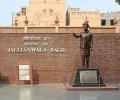
Former Supreme Court judge Justice Rohinton Nariman has warned that events similar to the Jallianwala Bagh massacre could occur if the 'basic structure' doctrine of the Constitution is diluted. In his new book, 'The Basic Structure Doctrine: Protector of Constitutional Integrity,' Nariman argues that the 1973 Kesavananda Bharati judgment, which established the doctrine, is essential for protecting fundamental rights and preventing constitutional amendments that could lead to such tragedies. Nariman's concerns are echoed by Supreme Court judge Justice K V Viswanathan, who applauds the book for its "chilling clarity" and underscores the importance of the Kesavananda Bharati ruling. The book provides a detailed analysis of the doctrine and its implications, highlighting the robustness of the Kesavananda Bharati judgment and the lack of a compelling alternative theory.

Amid this unrest came the verdict of the Allahabad high court on June 12, 1975 that found Gandhi guilty over discrepancies in the electoral campaign, which led to the Emergency on the night of June 25.

Referring to the enactment of the Chhattisgarh Auxiliary Armed Police Force Act, 2011 which created a trained force to aid and assist the security forces in maintaining law and order in the state, the bench said in its view it cannot be said to be an act of contempt of the order of 2011 passed by this court.
 © 2026 Rediff.com - Advertise with us - Disclaimer - Privacy Policy - Sitemap - Feedback - About us - Terms of use - Grievances